“Somme. The whole history of the world cannot contain a more ghastly word.” – German Officer, Friedrich Steinbrecher
After renting a car at the Paris airport, Neil, Sean and I began our trek into a French landscape that saw an indescribable amount of destruction during World War One’s Battle of the Somme exactly 100 years ago. As we drove north of Paris towards the Belgian border, I took in the picturesque landscape while my apprehensions about Neil’s driving faded away. It was his first time driving standard in nearly 30 years and he was doing really well. The odd jerk and false start was manageable. “Let’s keep this up, please, Dad”, I warned from the backseat. Sean was the navigator (we had to use both the car’s GPS and the Map app on Sean’s iPhone due to France’s love affair with roundabouts), so my contribution was offering unsolicited encouragement and reminders of when we last ate.
Our first destination of the day was the Thiepval Memorial, built between 1928 and 1932 in memory of the 72,000 British and South African men who have no known grave after dying in the Battles of the Somme (July 1915 – February 1918). “British” obviously includes the commonwealth soldiers. The Somme is known as one of the bloodiest battles in history, with more than one million soldiers wounded or killed. Of the names inscribed at Thiepval, 90% are believed to have died during a five month period (July – November 1916).


July 1, 1916 – the beginning of the First Battle of the Somme – remains the bloodiest day in the history of the British Army, with 60,000 British men wounded (a third of whom did not survive). In order to properly reflect the magnitude of this sacrifice, it is no surprise that Thiepval’s imposing stone and brick archways, which are engraved with the names of the missing, make up the largest British battle memorial in the world.
Every Canada Day, as we are celebrating the birth of our country on this side of the Atlantic, a memorial service is held at Thiepval. And just a short walk away, on the outskirts of the Thiepval Wood, a ten-year-old visitors’ centre tells the story of the landscape’s destruction and the men who took part. It is a visual history completely unrecognizable to the tourists looking out of the centre’s floor-to-ceiling windows onto green pastures and budding trees.


Though the fighting at the Somme ceased nearly a century ago, there are still reminders of the lives lost and buried beneath the manicured grass. Sometimes, bodies are discovered on the old battlefields. When a soldier is successfully identified, their name is removed from the memorial so as to protect Thiepval’s purpose in specifically commemorating those who are missing. The newly found soldier is then given a proper burial with full military honours at a nearby cemetery. A close observer will notice the odd gap in the carefully measured engravings where a soldier’s name used to lie.
The title “The Battle of the Somme” is misleading because it suggests a singular operation or battle site. The reality is that the Somme was made up of a myriad of sub-battles, night raids and full blown offensives along a 16-mile front that claimed the lives of men from all over the world. Some lasted hours, days, weeks, months and years. Besides its infamous casualty rate, the Somme saw the first appearance of tanks (a British invention) as well as newly discovered sources of air power. At the end of the three-year-battle, six miles of land were gained by the Allies into German-occupied territory. To put this into perspective, this is the equivalent of the walking distance between the Streetcar loop at Neville Park Blvd. and Spadina Ave. in Toronto.
Of the 72,000 names carved into the Thiepval Memorial, seven belong to winners of the Victoria Cross. The families of these men, whose bodies were never found, each received a small bronze cross with the simple words “For Valour” inscribed underneath the royal crest at its centre.
For Sean’s birthday this July, I gave him a book called Valour Road (and then told him I’d be reading it first). Author John Nadler tells the true story of three soldiers living on the same street in Winnipeg who enlisted in the First World War and went on to each win the Victoria Cross. Only one survived. As Nadler wrote, “Three VC heroes from little Pine Street. It was a startling revelation. And unprecedented. There was no other street in Canada, Great Britain, or the wide Empire that had distinguished itself in such a way.”
Pine Street’s name was changed to Valour Road after the war, and the stories of the men who once lived there are memorialized in a “Part of our Heritage” commercial that all of us children of the 80’s and 90’s will remember either watching in class or at home after school. Understandably, the short clip does not encapsulate the entire story of each soldier’s bravery. But I really wish these vignettes had wider circulation and more air time. I’d much rather watch Historica Canada’s work than a CBC commercial for “Dragon’s Den” or Global TV’s soul-wounding “Huh!” promotions.
Each of Pine Street’s VC winners served in the Somme or surrounding areas. One of these men, Leo Clarke, fought at Pozières Ridge – a battle recognized at Thiepval. Here is Leo’s story, as told by Historica Canada:
Corporal Leo Clarke won his V.C. in the trenches during the battle of the Somme. Clarke had found himself alone, under attack by 20 enemy soldiers. Instead of surrendering, Clarke attacked, emptying his revolver twice and then firing a German rifle he picked up from the ground. In the struggle that followed, a German officer bayonetted him in the knee before Clarke could shoot him. Wounded and bleeding, Clarke kept up the attack, and as enemy soldiers fled Clarke followed, killing four more and taking a prisoner. Though he was ordered to hospital, Clarke returned to battle the next day.
According to Nadler, “Leo had no real idea how many men he was fighting, and as more and more riflemen rose up and stormed furiously toward him, he might have wondered if the line would ever end.”
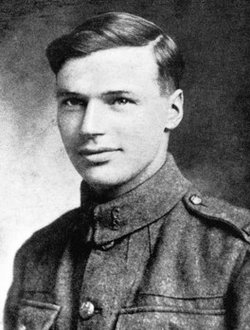
After Leo Clarke’s experience at Pozières Ridge, he wrote the following to his parents back home in Winnipeg: “I don’t care so much for the Victoria Cross as getting home for a couple of months.”
Luckily for historians and us, Leo’s younger brother Charlie kept a detailed account of both his and Leo’s service. The Clarke brothers both served with the Second Battalion Bombers. A month after Leo’s VC-winning endeavor, their battalion was relocated to the trenches of Courcelette. One October morning, Charlie looked on as a group of British officers (the “brass”) from headquarters paid a visit to the trench he and the rest of his bombers were securing. He watched incredulously as these officers held a noisy discussion over maps and used binoculars to try to identify the German-held trench directly in front of them. A seasoned bomber, Charlie knew that enemy sentries watch for the flash of sunlight off of glass. Only officers used binoculars and officers were, understandably, a main target. It was more than Charlie could bear as he watched these men proceed to step up onto the parapet of the trench, in plain sight of the enemy.
Charlie stepped forward. “Sir, do you know you are in full view of the Germans?” he asked. But they shot him “filthy looks,” and continued their reckless reconnaissance. Charlie knew from experience that they were in danger of an artillery strike, so he called Lieutenant Hoey. Hoey also warned the brass not to show themselves, but they ignored him as well. The officers soon finished their scouting expedition…They had only just left the Second Batallion trench when the shells started to fall.
The protective hole in which Leo Clarke was crouching was in the same stretch of trench that the officers had just vacated. The wall of Leo’s trench completely collapsed under the ensuing German artillery fire and his brother Charlie, also reeling from the bombardment, knew instinctively to look for him. It took a couple of men to dig Leo out of the earth that had enveloped him. While Charlie was relieved to find Leo alive, he knew right away that his brother was fading. Leo knew too. “He told Charlie to take his Colt revolver and his wallet from his pockets, instructing him to ‘spend his money on treats for the boys.'” Leo died a few days later.
Charlie was informed of his brother’s death and that Leo would be an official recipient of the Victoria Cross at the same time. But he couldn’t dwell on either news for long. Charlie’s battalion was immediately given marching orders, with a stop that included the infamous German-held high ground, Vimy Ridge.
***
 Just To Clareify
Excellent post, Clare. You have left me hanging, looking forward to the next installment.
Love Uncle T
Thanks a lot, Uncle T! I think you’d like the book.